What is POSH Training?
In 2013 Government of India enacted the Sexual Harassment of Women at Workplace (Prohibition and Redressal) Act, 2013 also called as the POSH Act The Act holds an organization and the employer responsible for taking measures to prevent incidents of sexual harassment at workplace The Act also lays down several measures for organizations to be compliant to the Act One of them is spreading POSH awareness to all the employees in the organization about their roles and responsibilities through training program and similar initiatives It is advisable to conduct such trainings at least twice in a year.
Why POSH Training?
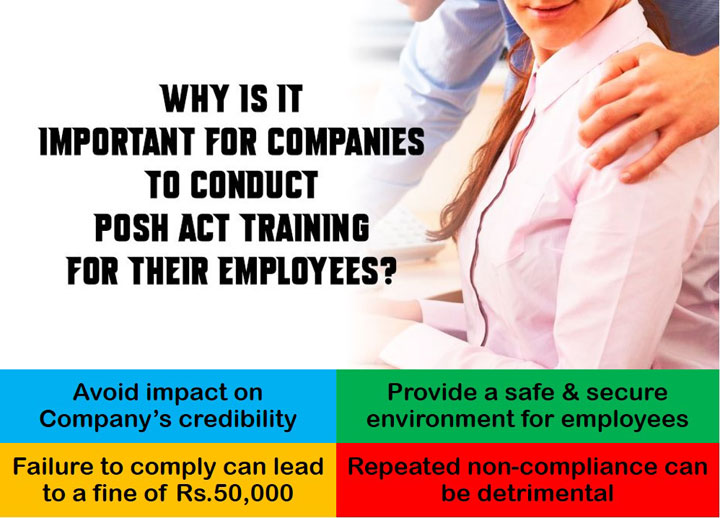
Firstly, it is legally mandatory to conduct POSH training The organization can attract heavy penalties like a fine of INR 50,000 for first time offence and cancellation of business license for repeated offence if the law is not followed In addition, just having a law does not help Many a times, women question whether a particular behavior can be counted as sexual harassment even after they felt uncomfortable or violated So, it is important for employees to know what is acceptable in the workplace, what constitutes to sexual harassment and what does not
Moreover, the employees should also be aware about what to do if their colleagues are subjected to sexual harassment An effective training on POSH can address these issues Organizing POSH training is a step towards protecting the rights of women employees and ensuring equality at the workplace Training must be given to all employees regardless of their gender or designation.
What are the POSH Benefits?
- If you think the above mentioned are not good enough reasons to organize POSH training, here is a list of more benefits in conducting POSH training for the organization
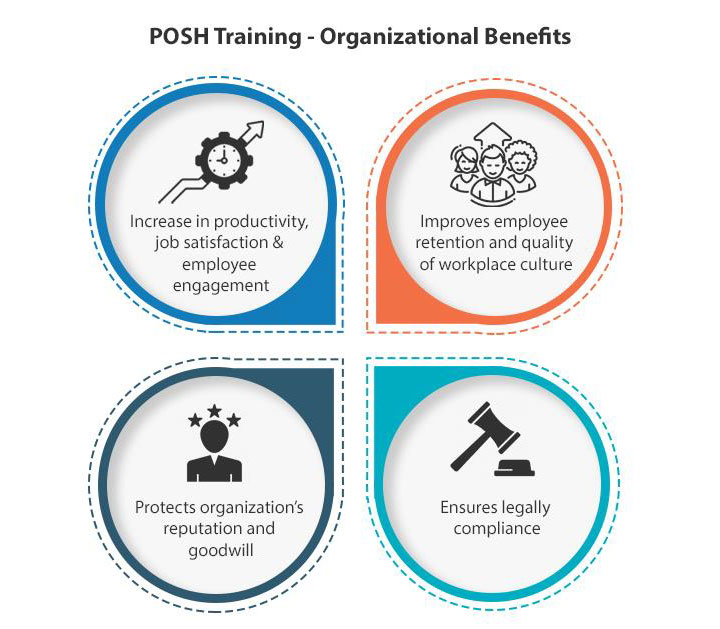
- Sexual harassment can hamper productivity of not only the victims, but also other employees Better the training, lesser the incidents of sexual harassment and higher the productivity
- POSH training shows that the organization cares about the employees which can increase job satisfaction and employee engagement
- POSH training improves employee retention and the quality of workplace culture In general, the training improves the perception of employees about the organization
- The reputation and goodwill of an organization can be damaged if employees decide to reveal their horrible experiences of sexual harassment via social media Organization may lose its customers as well Sensitizing the employees through POSH courses and programs can safeguard the organization s reputation and ensure customer retention
- Like mentioned before, non compliance to the act can attract penalties There can also be chances that the legal fight can take a long time which will result in a huge financial impact Conducting regular POSH training and awareness programs will not only help in avoiding such legal tangles but can also act as a proof in the court that the organization had taken necessary steps for prevention of unfortunate sexual harassment incidents
What should you cover in POSH training
All employees in the organization managers, directors, IC members, human resource professionals and employees must go through the training However, a one size fits all training will not help A common training on the law is important In addition to this, there should role specific training as well For example, Internal Committee members (IC is the institution that will inquire into and redress sexual harassment complaints within the organization) must go through specific training on the inquiry procedure and redressal mechanism Let us have a close look at what types of you should consider for your organization.
POSH Foundation Course
- This course will cater to the entire workforce in the organization. Regardless of the gender or designation, every employee should have a clear understanding of the following:
- The term sexual harassment, what constitutes to sexual harassment and what does not.
- Who are complainant, respondent and what are their rights?
- What do workplace, employee and employer mean in the context of POSH Act?
- IC, its responsibilities and the name and details of IC members of their organization.
- Means of filing a complaint
- The punishments for sexual harassment
- Tips to prevent physical/online/virtual sexual harassment
- Things to keep in mind to prevent sexual harassment arising out of personal relationships
- The consequences of filing a false complaint with malicious intent
- The consequences of retaliation
- Responsibilities of a someone who has witnessed harassment
- The responsibilities of an employee in preventing sexual harassment in the organization
POSH Training for Managers / Team Leaders / Supervisors
A certain section of the employees has a team to manage and is obligated to provide a safe environment to their team members They can be People Managers, Reporting Managers, Business Heads, Human Resources (Learning and Development) professionals, Diversity and Inclusion (D& champions, etc The POSH training for them must enable them to effectively handle and manage sexual harassment incidents Any inappropriate step or negligence on the part of the people manager will have severe consequences to the organization, team and the victim.
Ideally, the POSH training for managers should cover:
- The key responsibilities of leaders if there is an incident of sexual harassment
- Steps to objectively document the complaint
- Cooperating with the IC for investigation
- Things to do post inquiry
- Proactive measures that can be taken to prevent unfortunate incidents
POSH Training for Internal Committee Members
The POSH Act mandates that any organization with more than ten employees (including temporary contract employees or interns.) should constitute an Internal Committee which will have the power of a civil jury. They will inquire into POSH complaints and redress them.
As the Internal Committee plays a significant role in the organization’s mission of preventing sexual harassment at workplace, proper enablement of the Internal Committee is necessary.
Goals of Sexual Harassment Training
The purpose of this training is to:
Ideally, the POSH training for managers should cover:
- Discuss what is harassment
- Discuss what is sex discrimination
- Discuss what is sex stereotyping
- Discuss what is sexual harassment
- Discuss targets and perpetrators
- Discuss where sexual harassment can occur
- Discuss what to do if you are harassed of witness harassment
- Discuss supervisors ’ responsibilities
- Discuss investigation and corrective action process
- Discuss retaliation
- Discuss what is not retaliation
- Discuss additional resources
It is important to train the IC members on the following:
- The responsibilities of an IC
- The members of IC and their qualification
- The criteria to disqualify an IC member if the need occurs
- The steps of filing a complaint and the procedures that follow
- The process of conciliation and inquiry
- Differentiating sexual harassment from gender based discrimination
- The jurisdiction of Internal Committee
- The procedure of conducting interviews required for the investigation
- The deadline to complete the inquiry and report submission
- The recommendations to be made after the inquiry
- Preparing the inquiry report and the details to be included in the report
- Preparing and submitting the POSH Annual Report
Mode of POSH Training Programs
Many organizations contemplate on what mode of training they can use for POSH awareness Should you go for POSH classroom training workshop or POSH online CBT modules? It mostly depends on the organization s discretion because both eLearning and classroom training have their own pros and cons However here are a few things you can consider while choosing the right mode of training
It is better for you to choose offline mode of POSH training Here is why?
- The understanding and the goal of training is well achieved in personal interactions
- Participants can be in rapport and brainstorming can done in a better way
- Participants can get the satisfactory answer by the trainer in detailed discussion
- Communication s maximum part deliver in non verbal mode so its better to get maximum and efficient to it
- Participant can get the solution of their problems and issues in a better way
- There are lots of opportunity to understand practical application of the learnings
Who We Are? What We Do?
PUNLP is a POSH – Prevention of Sexual Harassment at Workplace compliance advisory body. Our team consists of POSH consultants, workplace diversity advisor, lawyers, psychologists, counsellors, having work experience of more than 20 Years. We aim to help organisations put in place all the mandatory compliance, enabling workplaces to be inclusive, diverse and gender neutral.
What Makes Our POSH Training Effective
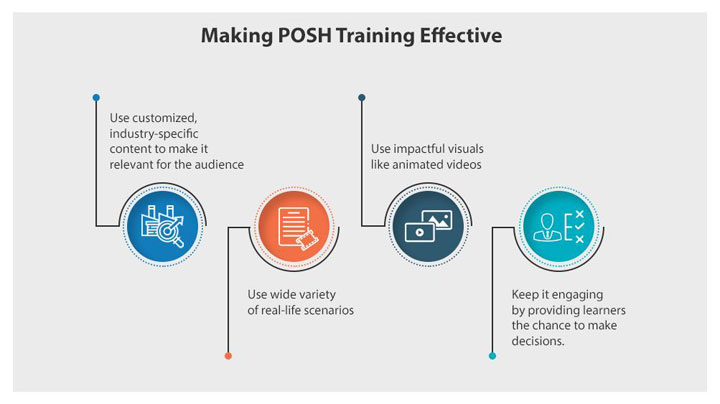
- We have seen that there are several topics to be covered in each type of training This can make the training long and boring Here are a few tips to ensure that the learners stay engaged through out
- Include examples and content relevant to the industry and the audience Incidents that happen in a manufacturing industry is not similar to what would happen in an IT company
- Use scenarios to understand the intricate nuances involved in sexual harassment incidents Instead of telling that the employees should intervene, give an example of how an intervention by a fellow employee has saved a coworker from sexual harassment It will be more effective
- Use impactful visuals (like animated videos) about points that the learner should retain Humans are visualcreatures
- Give learner chances to take decisions Give quizzes and activities to the learner that involve examples or scenarios Ask them what they would do in a relatable situation and let them know why their response was correct or incorrect This keeps them motivated to continue the course
- Ensure that along with the white collar workforce, blue collar workforce is also aware about their rights and responsibilities as per the POSH Act However, it is not always easy to train them as they speak different regional languages, may not be very comfortable in English and may not have access to computers or laptops
- Give a token of appreciation for completing the course This can be in the form of a badge or a course completion certificate
POSH- Train The Trainer Program
These sessions are designed for individual trainers so that they can be trained as champions and continue the process of raising awareness among other employees in any organization. To prevent sexual harassment, it is critical to educate employees on what constitutes harassment and how to avoid it. This can be accomplished through training programs and policies that outline expectations and consequences for inappropriate behavior- with the train- the- trainer program, individuals are capable of imparting knowledge within organizations themselves.
Key Importance of Program

- The “Me Too” and “Time’s Up” campaigns have brought the serious issues of Sexual Harassment of Women (SHW) to light and fostered solidarity among survivors.
- SHW encompasses a wide range of behaviors, from verbal transgressions to sexual abuse or assault.
- SHW is discriminatory because it may result in the survivor’s demotion, firing, or quitting, as well as a hostile work environment, and all organizations are stretched to the limit by competition, and their survival depends on maximizing the use of their resources and a gender-sensitive environment that leverages intellectual and physical capabilities without hindrance.
- Employee are required by the Sexual Harassment of Women at Workplace (Prevention, Prohibition, and Redressal) Act, 2013 (POSH) to organize periodic and regular training to sensitize all of their employees.
- The POSH – Train The Trainer (POSH-TTT) is useful and realistic. It emphasizes key legal provisions, statutory compliances, and the consequences of non-compliance. It actually aids in the discovery of solutions.
- Because the course is a Train-The-Trainer, the competence to deliver these programs become available in-house and can be quickly deployed to train the entire organization. It also benefits freelance trainers who want to expand their offering to include this vertical.
- Participants will gain a solid understanding of the legal, corporate, and training aspects of POSH and will their own organizations and for their clients.
Who Should Participate
- Graduates in any discipline with work experience in HR, Training, Teaching, Learning & Development, and Social Work will be given preference. Trainer abilities are desirable but not required. Organizations should train an interdisciplinary team of men and women managers from various departments.
Aim - What You Can Expect
- Participants will be able to: Describe the concept as well as the importance or Preventing, Prohibiting, and Addressing Sexual Harassment in the Workplace at the end of the training.
- Explain, using examples, what constitutes sexual harassment and what constitutes a hostile work environment.
- Examine the Vishakha Guidelines as a forerunner to the Sexual Harassment of Women Act of 2013.
- Analyze various provisions of the Sexual Harassment of Women Act, 2013 – definition of Sexual Harassment, the constitution of Internal Committees, the procedure of filing Sexual Harassment complaints, the investigation into complains, actions during the pendency of the investigation, duties of employers, and so on.
Credential & Assessments
- Participants with 100% attendance will receive ‘Trainer Certification’ from Progressive Universe of NLP (PUNLP).
- Participants will be evaluated theoretically and practically at the end of the three-day program. Participants must pass an examination on the final day of the program to be qualified for the Certification. Those who achieve a score of more than 60% will be eligible for the Certification. Those who do not pass the exam will have to retake it.
Curriculum
- Understanding the term ‘Unwelcome’.
- Physical vs. virtual sexual harassment.
- What factors may contribute to sexual harassment?
- Comprehensive understanding of ‘Quid Pro Quo’ and ‘Hostile Work environment’.
- Understanding the Employee, Workplace, and so on.
- Process of Complaint Filing and Redressal Mechanism.
- Internal Committee (IC): Membership, Terms, and Removal.
- Process for Filing a Complaints- Process for Redressal.
- The implication of Malicious Complaints.
- The significance of maintaining confidentiality.
- Bystander effect: Your role when you witness or observe sexual harassment.
- Organizational vision, things to remember, and prevention.
- Insisting on the purpose of the law and policy.
- Organizational values and mission- Rights and responsibilities of each employee- Empowering employee to deal with instances of harassment outside the workplace such as stalking and voyeurism.
- Using media to violate privacy, and so on.
- Prevention Measures (including a focus on what to do and what not to do while working from home).
Benefits of Our POSH - TTT Certification
- Consistent earnings from training and evaluation.
- Consistent ongoing different training project for work.
- Timely regular payment cycle.
- Workplace independence.
- Free- Associated Trainer’s Specialized Training Program for Skill and Self Development.
- The ability to select clients and projects.
- Massive earning potential.
- Exposure to various industries and training functions.
- Excellent opportunity to test your innovation and creativity on a variety of projects.
- Thriving on a wide range of projects.
- The best platform for achieving work-life balance.
- Coaching and mentoring.
Download POSH Certificate For Organizations


 +91-7617777911